
Category: Island Life
You are viewing all posts from this category, beginning with the most recent.
Island Calendar Solutions
In continuing to speak with people on the island, the glaring unmet need is for an island-wide event calendar. I also bear witness to a very strong desire to rid ourselves of corporate social media, with multiple people I’ve spoken to already taking steps.
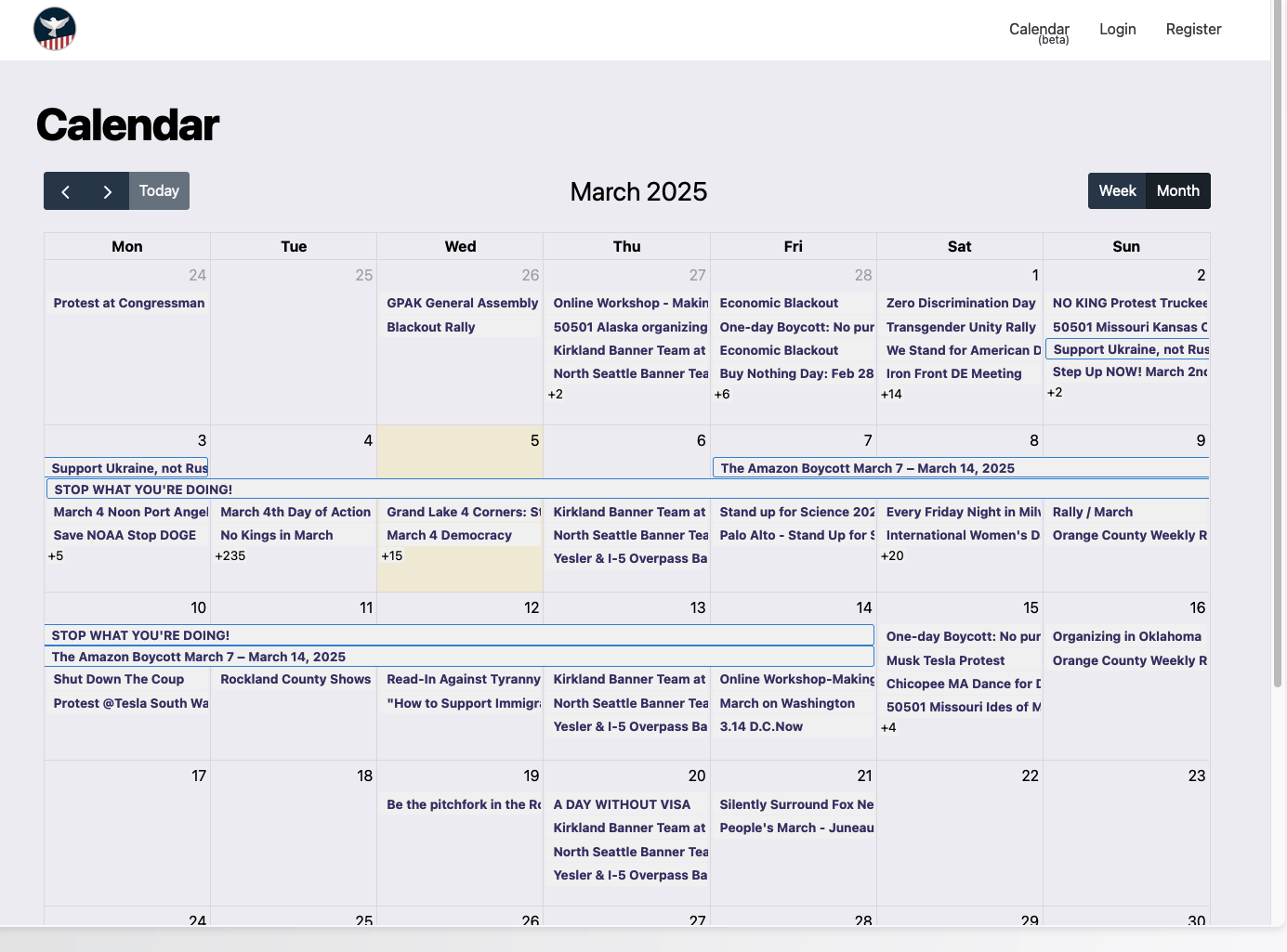
Here’s an exploration of what exists in this realm, and how the off-the-shelf event/calendar ActivityPub enabled open source projects stack up to the island needs.
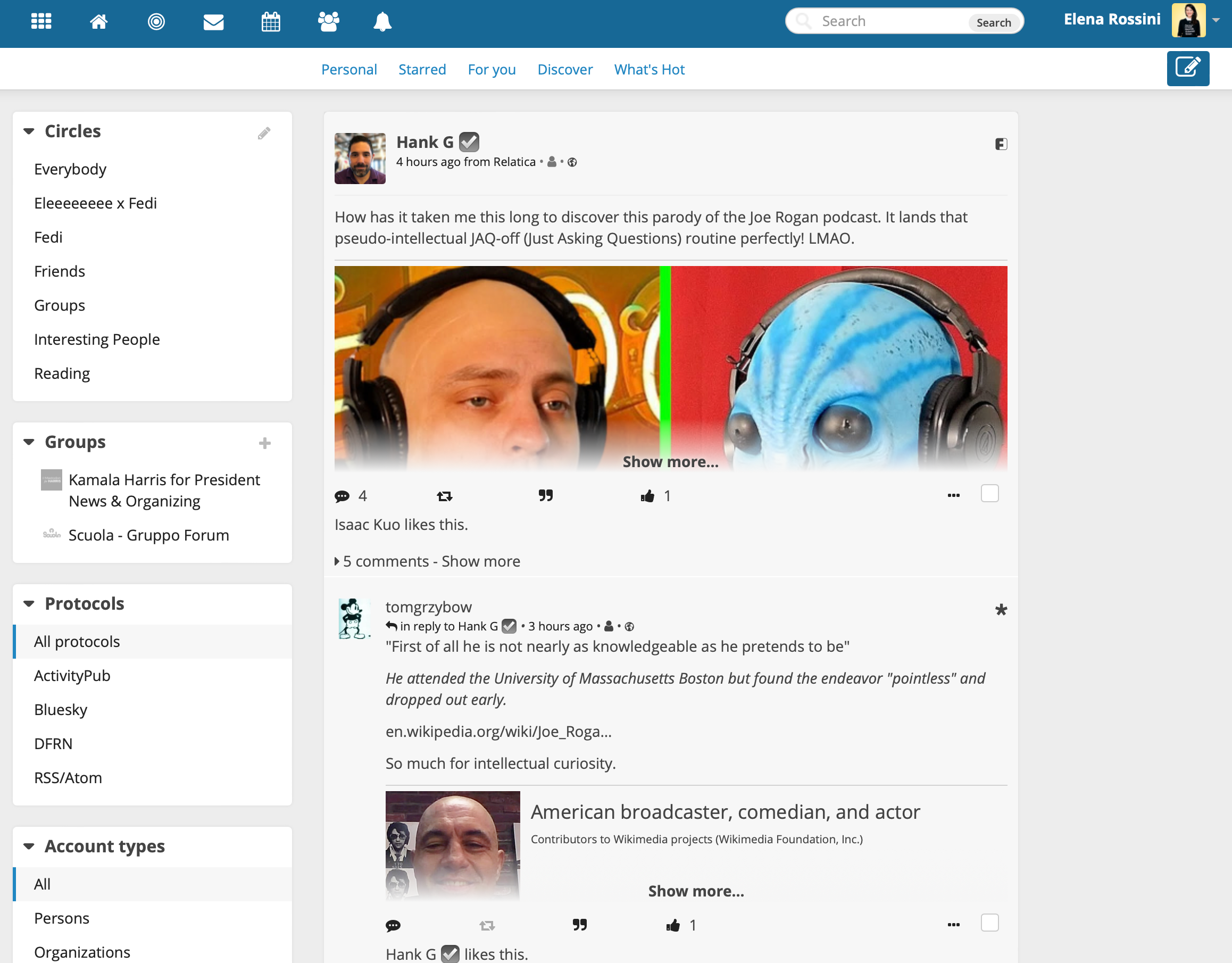
Friendica is one of the more popular ActivityPub applications. In essence it’s a Facebook.com alternative that prizes itself on also being a bridge to and from other social networks. It would probably be one of the most understandable to onboard people onto because it would be the most recognizable. A negative is that it’s a bit overwhelming because it can do so much stuff.
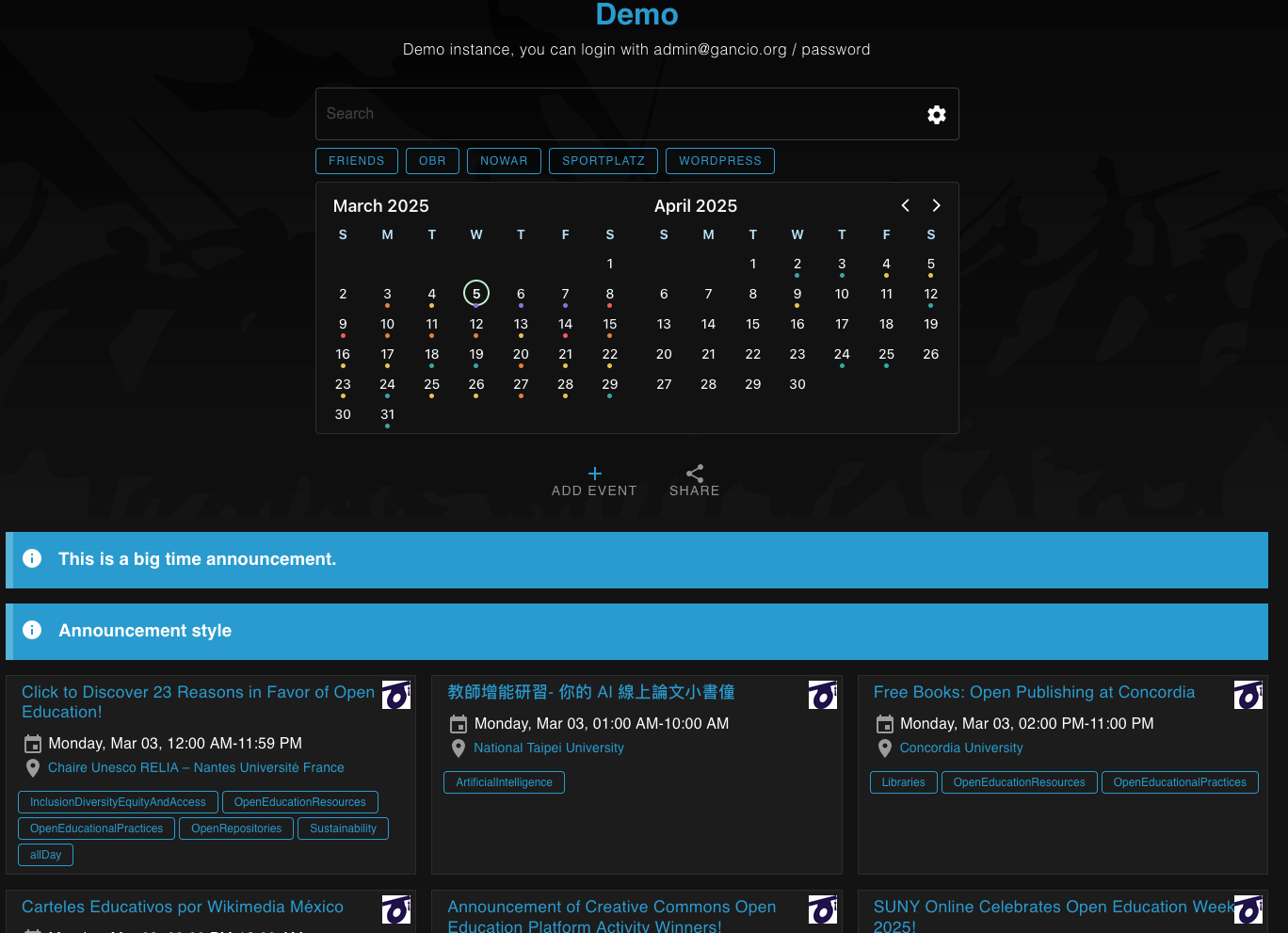
At this point I believe Gancio powering the calendar would be a good choice as it offers the simplest execution of the biggest need. That said, it’s insufficient in and of itself as a community social media solution.
I think pairing Gancio with another ActivityPub enabled solution would be the trick. That could be a microblogging option like Mastodon or Pleroma, Gancio combined with Friendica or any number of other potential applications in the Fediverse.
There’s also loads of other considerations at play, such as what language the services are written in, what application clients exist, how committed the teams are, etc. Additionally, while the island community uses a LOT of Facebook and Instagram, there’s way fewer people interested in Twitter style microblogging. So all this is a very surface level exploration.
One note, integrations between ActivityPub enabled services either directly on the back end, or just using the power of ActivityPub!
Feature Idea It’s lonely and off putting to sign into things and have to immediately find people. Since people are signing into a community social network, every account ought to be seeded with people to follow, probably organizations. You could also have a few “ambassadors” in the community who would be seeds for people signing on.
editors note It’s taken me the whole post to figure out how to consistently spell calendar. Embarrassing.
Community Social Media - How it Could Work: The Homepage
This is the start of an overview of how community social media could be set up. This isn’t implying that everything is the right answer, a lot of that will happen via design and implementation, but can be used as the start of a high level overview.
I believe the best implementation of community social media is in discreet and definable communities, with lots of overlapping relationships, and I am on Orcas Island (population 7k), I’m using Orcas.Social as the placeholder URL. It’s clear, clean, and easy to remember. As time goes on different branding / defined community may make more sense.
The Homepage
The homepage will be the first interaction most people will have, so it’s key that it bears in mind execution risks for adoption. This means it’s key that it delivers value from the very beginning.
The homepage goals are:
- Provide immediate value without requiring account to community members, organizations, businesses and tourists.
- Provide increased value to those logged in with an account
- Lead in to onboard people into creating an account
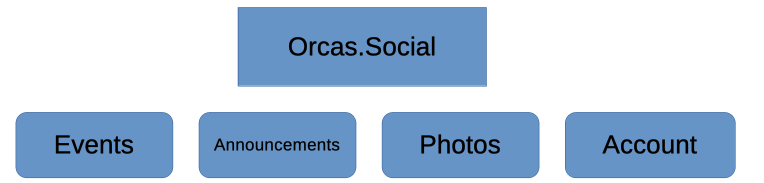
We have a good sense for the needs from the early community conversations. This informs the content on the homepage.
It’s also worth noting that this content will be filtered and curated to maximize value and minimize noise. There will also be some quick filter links to quickly get to needed information, like school, kid-friendly, 21+ and over, free and open to the public, etc.
Events: These are pulled from (and link back to) a community calendar.
Announcements: A feed of important announcements or information. You could envision information about power outtages, unusual openings or closings, etc.
Photos: We want to set the stage for Orcas.Social to be a place to experience awe, beauty and friendliness this island has to offer.
Account: We do want to make sure people see that they can log in for a more customized experience. The account creation on boarding will be so vital, and so recognizing that the homepage will be a key part of the first step.
Imagine going to Orcas.Social to see what you could do with the kids on Saturday. Because it collects events from a lot of sources, you able to easily see that roller skating was cancelled, but see that there’s an all ages concert at OddFellows and a screening of the latest animated movie. Two of your favorite restaurants are closed but you see there’s a food truck popup at Con’s. You and your family decide to check out the concert, grab some food at the pop-up, and then decide whether to go back to the all-ages concert or watch the movie!
A Community Strategy for Degrowthing Corporate Social Media
As I’ve mentioned, I think corporate social media is knowingly hurting society due to its incessant need for growth. I believe the Fediverse, the collection of applications built on ActivityPub, provide the start for solutions.
The core question with social networks though isn’t the features or quality of the code, but who is on and using it. A social network is only as good as the people using it. Called the network effect, it’s the inherent value that exists within social relationships. The more people are on the network the more valuable it is. The inverse is also true. The fewer on the network, the less valuable it is.
Modern social networks grew by optimizing the ease at which people could get on the network and connected to people with features that would drive initial stickiness and engagement. Then once they had momentum, would implement features to drive even more repeat engagement. They prioritized features that give little dopamine hits that make people keep coming back and keep scrolling. Their number one goal isn’t value but addiction.
Any features or value that they bring to you is an incidental byproduct on their path to addicting you to their product. They take your engagement and build an online profile of you, track you across every digital thing you do, and use that to sell and market products to you. Their goal is serve their customers needs and you are not their customer. You (and your data) are the product they are selling to their true customers: advertisers.
You may rightly point out that they do bring value. They allow you to share photos, thoughts, and links. They provide information about businesses, allow groups to connect, communicate, and share events. For each person and community they provide different amounts of value, sometimes keeping people engagement for just a small part of the feature set.
For example, on Orcas Island, almost everyone uses Facebook because that’s the only way to connect to important groups like the Orcas Buy/Sell/Trade, the only way to trade ferry reservations, the fastest way to get the latest island news, and see events.
This is what we need to provide for ourselves, off of corporate social networks.
Our purpose in this work will be to live better, healthier and more connected lives with stronger relationships to each other.
Our goal will be to remove our dependence on corporate social media.
We will take a community approach by looking at the dependence as a public health problem.
–We will look at the key needs of the community and then provide open source, locally operated solutions. –Then we will partner with key island stakeholders to provide initial content and adoption, creating “life” if you will –We will then create a community onboarding plan, helping different groups onboard each other
A key perspective is that this isn’t a technical solution, it’s one based on community and relationships. Most everyone I speak with acknowledges the problem of corporate social media but doesn’t know what to do, and can’t individually move people there.
An example of a need is an island-wide event calendar, and working with specific groups to use a community-owned standard. About making sure that important places like the school, chamber, etc are putting events in it, giving them access to posting that, and having them point to that calendar. When it’s challenging for a particular stakeholder to do so, provide technical or manual solutions to solving it.
It’s okay if someone has to manually copy a Google calendar to this new system to start. It’s okay to make a specific ask of a specific person to help this initiative. There’s only 7,000 full time residents on the island and maybe 30k in the county. We can work together and help each other get off corporate social media.
It’s fundamental that this isn’t a technology problem, but a community problem, with community solutions. And the end result will be us taking our community’s health into our own hands and providing solutions together.
Deviralling Corporate Social Media
Corporate social media is hurting us, but it’s intertwined with so much of our lives. It’s not clear there’s another option, and when one “goes down” another, more addictive and equally destructive, pops up. Often times the new ones, like Bluesky or TikTok, appear better, but they will always get more and more destructive. They have a structural needs to grow users and revenue due to the fact they’re beholden to shareholders and advertisers.
Alternatives exist. Thanks to the open standard ActivityPub, and often refereed to being connected to the Fediverse. There’s all kinds of decentralized social networks to accomplish a variety of tasks. Though many are newer, they have the advantage of being able to run in small servers, customized to a community’s needs, and are almost all open source. The key power of ActivityPub means they’re all interoperable, so that even if you use a small private server, you can see and interact with others on different applications.
An example is Mastodon. There’s thousands of public and private servers out there. I’m on Mastodon.ie run out of Ireland. I follow hundreds of people throughout the world almost all using different versions. While there is a Mastodon application, I use a different one called Ivory. If I want to take my Mastodon account to a different instance, I can.
All kinds of Fediverse applications are built on ActivityPub. The most popular is Mastodon, which is a Twitter/X/Bluesky microblogging service. There’s Lemmy, which is meant to function like Reddit. PixelFed, which has a Instragram like focus on photos. Loops for TikTok. PeerTube for YouTube In addition to these sets of features, applications built using AcitivyPub are also interoperable. Imagine if Instagram, TikTok, Facebook and Twitter all shared feeds.
ActivityPub alternatives have challenges like limited adoption, can be intimidating, and have a high adoption for the average person. There are hundreds of people working on solving these problems from a design and technical standpoint. Which is great. They’ll only get better, more fully functioning, as time and adoption grows.
Corporate social media is very sticky. They’re excellent at getting you on their service, and even better at keeping you there. They spend billions of dollars to try and keep you addicted, even at the expense of your and your communities health. They seem they have a near invincible hold on attention and our society.
The good news is history is rife with dead social networks. MySpace, Friendster, and soon Twitter all seemed like they had huge holds. But as fast as alternatives gained viral adoption, these dead networks slowly disappeared into irrelevance. That means that even if Facebook seems invincible, it is very much built with clay feet.
Instead of trying to compete head to head with corporate social media on the areas they spend billions, leverage what is unique and powerful about Fediverse applications, take ActivityPub’s advantage of small scale, the customizability of the open source software, and build locally for small communities.
**We can de-viral corporate social media **from our lives by approaching it not as a technology or design problem, but as a public health problem. Almost everyone acknowledges a bunch of the ills of social media, we need to help engage in conversation with them on the full harms, understand their needs, make sure alternatives can meet those needs, and onboard them to the alternatives. We can onboard people one at a time, iterate on the product offering, and slowly get people off corporate social networks.
I live on a smallish island of 7,000 full time residents that balloons to above 20,000 in the summer. Facebook, Instagram and Twitter are all interwoven into the fabric of our community. But they don’t have to be. They’re hurting our community, and we can stop them together.